

Your breasts don’t always change in the ways you expect. Pregnancy, weight fluctuations, breastfeeding, and aging can gradually affect their shape, fullness, and position. One day, you might notice that your favorite bra fits differently or that your breasts no longer have the contours they once did.
Fortunately, breast enhancement surgery offers several ways to address these concerns. Breast lifts can reposition sagging breasts, while implants can increase volume and improve fullness. For some patients, combining both procedures offers a more complete transformation.
Keep reading to understand the differences and discover which option may be appropriate for your goals.
7 Key Differences Between Breast Lifts and Implants
Although breast lifts and implants are frequently discussed together, they serve different purposes. Understanding how they compare can help you identify which approach may be appropriate for your anatomy and desired results.
1. A Breast Lift Changes Position, While Implants Add Volume
The biggest difference between these procedures comes down to what you’re hoping to change. Are you unhappy with the position of your breasts, or do you wish they were fuller?
A breast lift, medically known as mastopexy, removes excess skin and reshapes existing breast tissue. The surgeon repositions the breasts and, when necessary, raises the nipples to create a more elevated appearance. Breast implants, on the other hand, increase breast volume by adding fullness and projection.
Implants can improve breast shape, but they don’t reliably correct significant sagging. This distinction is especially important when comparing breast lift vs. augmentation procedures. Patients who want higher breasts may benefit from a lift, while those seeking greater size may prefer augmentation. If both concerns are present, combining the procedures may be worth discussing.

2. Sagging Determines Whether You Need a Lift
Breast sagging, also called ptosis, occurs when the breasts gradually lose their elevated position. Aging, pregnancy, weight changes, and genetics can all contribute to this change.
One important consideration is the position of the nipples relative to the breast crease. When the nipples sit at or below this crease, a breast lift may be recommended depending on the degree of sagging. Surgeons also evaluate skin elasticity, breast volume, and the overall shape of the breasts.
Some patients experience what is sometimes called pseudoptosis. This occurs when much of the breast tissue settles below the crease, even though the nipple remains relatively elevated. These differences influence which surgical technique may provide the most appropriate correction.
For patients researching sagging breasts surgery in Canton, MI, understanding their specific anatomy is more useful than choosing a procedure based on photographs alone. A consultation allows the surgeon to evaluate breast positioning and explain whether lifting, augmentation, or a combination may address the concern.
3. Implants Create Fullness That a Lift Cannot
Some women are satisfied with the position of their breasts but wish they had more volume. Others notice that their breasts look smaller or less full after pregnancy or significant weight loss.
Breast augmentation may address these concerns by increasing breast size and projection. Implants are available in different sizes, shapes, and profiles. The selection depends on factors such as chest dimensions, existing breast tissue, and the patient’s aesthetic preferences.
A breast lift doesn’t provide the same increase in volume. Although lifting can reshape existing tissue and create a more compact, elevated contour, it cannot replace substantial lost fullness. This becomes particularly important for patients who want a fuller upper breast.
A lift alone may improve shape without producing the rounded appearance some patients associate with augmentation. Choosing the right approach requires a realistic discussion about the difference between repositioning tissue and adding volume.
4. Combining Both Addresses Two Concerns
Sometimes the answer isn’t choosing between a lift and implants. It’s recognizing that both procedures may address different aspects of the same concern.
A breast lift with implants combines tissue repositioning with added volume. The lift removes excess skin and reshapes the breast, while the implant increases fullness and projection. This combination may be considered for patients who have experienced significant volume loss alongside sagging.
For example, a patient whose breasts became smaller and lower after pregnancy may want to restore fullness while improving their position. However, combining procedures creates additional surgical considerations involving skin tension, implant size, blood supply, and the amount of lifting required.
Some patients can undergo both procedures during one operation. Others may benefit from a staged approach, depending on their anatomy and surgical goals. A personalized assessment helps determine whether combining procedures is appropriate.
5. The Incisions and Scars Are Different
Every surgical procedure involves some degree of scarring. However, the location and extent of scars differ between breast lifts and augmentation.
Breast augmentation often involves an incision beneath the breast, although other approaches may be considered. Breast lifts generally require more extensive incisions because the surgeon must remove excess skin and reposition tissue.
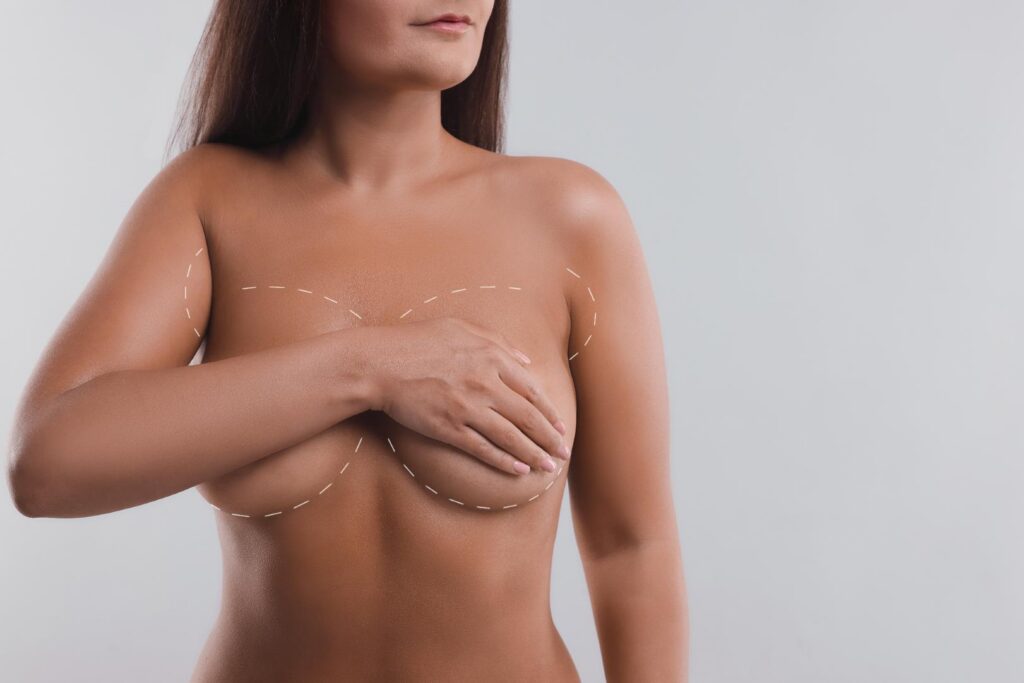
Depending on the amount of correction needed, lift incisions may involve:
- Around the areola: An incision following the edge of the darker skin surrounding the nipple.
- Around the areola and vertically downward: Often called a lollipop incision.
- Around the areola, vertically downward, and along the breast crease: Commonly called an anchor incision.
The appropriate technique depends on breast shape, skin excess, and the amount of lifting required. When augmentation and lifting are combined, the surgical plan accounts for both procedures.
Scars typically change in appearance as healing progresses, but they don’t disappear completely. Patients should discuss incision placement and expected scar patterns before deciding on surgery.
6. Recovery Depends on the Procedure
Recovery is another important factor when choosing breast enhancement surgery. Although both procedures require healing time, the experience can differ.
After breast augmentation, patients may experience swelling, tightness, and soreness as the tissues adjust. Breast lift recovery also involves swelling and discomfort, particularly around the incision sites. When both procedures are performed together, recovery may require additional precautions because the surgeon has repositioned breast tissue and inserted implants.
Many patients return to nonstrenuous daily activities within approximately one to two weeks, depending on their procedure and recovery progress. However, strenuous exercise, heavy lifting, and certain upper-body movements may need to be restricted for several weeks.
Patients should follow their surgeon’s specific instructions rather than relying on a universal recovery schedule. Final breast shape also takes time to develop as swelling decreases and tissues settle. Planning adequate recovery time helps patients approach surgery with realistic expectations.
7. Results Age Differently Over Time
Breast surgery can create meaningful improvements, but it doesn’t stop the natural aging process. Understanding how the breasts may change afterward is an important part of setting realistic expectations.
A breast lift repositions existing tissue and removes excess skin. Over time, gravity, skin elasticity, and future weight changes may affect the breasts again.
Breast implants maintain their manufactured volume, but the surrounding natural tissues continue to change. This means implants don’t permanently prevent sagging. Patients with larger implants may also experience additional tissue stretching over time, depending on their anatomy.
Future pregnancy, breastfeeding, and significant weight fluctuations can influence the appearance of either procedure. Maintaining a relatively stable weight may help preserve results, although it cannot eliminate normal age-related changes.
Choose the Change That Fits You
Breast enhancement isn’t simply about making breasts larger or higher. It’s about understanding which changes matter most to you. Breast lifts improve position and shape, implants add volume, and combining both may address multiple concerns when appropriate.
At Bazzi Plastic Surgery in Canton Township, MI, patients can explore personalized breast enhancement options based on their anatomy and aesthetic goals.
Schedule a consultation to understand the differences, discuss realistic expectations, and discover which approach may be most appropriate for you!